The Journalists Association of Korea
Press Release
Nov. 22, 2004
New Asia-wide journalist organization launched
A first for China in joining non-socialist international media organization; Lee Sang-ki named president, Kang Seok-jae as secretary general
SEOUL (Nov. 22) --- A new Asia-wide journalist organization has been launched as the first international media body to promote greater press freedom and solidarity among journalists in the Asia-Pacific region.
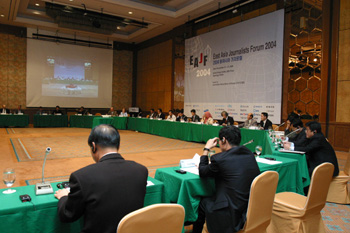
At the plenary session of the 2004 East Asia Journalists Forum, held on Nov. 19 in Gyeongju, Korea, participants founded the Asian Journalists Association (AJA).
The six-day forum, which started Nov. 16 in Seoul and later moved to Gyeongju, drew some 60 journalists from about 20 countries including China, Japan, Malaysia, Indonesia, Vietnam, Singapore, the United States, Russia, Germany and Australia.
Participants unanimously selected Lee Sang-ki, president of the Journalists Association of Korea (JAK), to serve as the new associations first president, and Kang Seok-jae, chairman of the International Committee of the JAK, as its secretary general, according to the JAK, which hosted the forum.
According to its charter, the AJAs highest decision-making body will be a General Assembly. The new association will also feature a 10-member Executive Council with one vice president from China, Japan, Singapore, Malaysia and Indonesia, with the final composition to be announced later this year. The headquarters of the AJA will be in Seoul, according to the organizations charter.
Forum participants also decided to set up committees to tackle specific media issues that are relevant to the Asia-Pacific region. Committees to be established will address areas such as journalist safety and welfare, international exchange, professional development, and solidarity and networking.
Over the last 10 years, several Asian countries have expressed an interest in establishing an Asia-wide international media association, but their efforts failed to materialize. In that regard, the JAKs successful efforts toward establishing the Asian Journalists Association as an international media organization are noteworthy.
Chinas admittance to the AJA is also significant as China has until now refused to join any non-socialist journalist organizations, such as the International Federation of Journalists, the International Press Institute, and the World Association of Newspapers.
In addition, though not present at the Seoul forum, representatives of the Philippines, Laos and Sri Lanka each issued supportive messages, thus expressing their willingness to participate in the AJA.
The Asian Journalists Association is being viewed as having set the stage for the era of a region-wide international media organization, in light of the interest expressed in it by Christopher Warren, president of the International Federation of Journalists, who was a keynote speaker at the forum, and the enthusiastic participation in the forum by such international media organizations as the Society of Professional Journalists (SPJ) of the United States, and delegates from Australia, Russia and Germany.
We have taken the initiative to launch an Asia-wide journalist organization to better safeguard press freedom and proactively deal with the changing media environment in the age of New Media, said Lee Sang-ki, the first president of the AJA, in his acceptance speech.
Lee said, I would also like to thank the SPJ, Russia, Australia and Germany for their full support for the launch of the AJA. I will do my utmost so that journalists around the world will, in 10 years, 20 or 100 years, forever remember the historic launch of the AJA today.
Meanwhile, participants in the 2004 East Asia Journalists Forum unanimously adopted a Resolution on Safety of Journalists, which seeks to address the increasing violence against journalists across Asia, most recently two Philippine journalists killed early this month.
The participants also adopted the Action Plan to Promote the 2003 East Asia Peace Initiative. The plan, drafted by Philippine Prof. Crispin Maslog of Nanyang Technological University in Singapore, calls for the development of peace journalism workshops, preparation of a manual on peace journalism and awarding of annual Peace Journalism Prizes.
Resolution on Safety of Journalists
We, delegates attending the 2004 East Asia Journalists Forum held in Seoul Nov. 16-21
Distressed by the news of the killing of two more Philippine journalists last week, a reminder once again of the continuing threat of violence against journalists all over the world,
Noted that to date over 500 media workers had been killed worldwide, including 55 in the Philippines since 1986; and concerned that we must rally around to counter and check such violence against media workers,
Hereby unanimously resolved as follows: That this meeting,
1. Condemns the criminal acts of violence, intimidation and threats against working journalists in the Philippines, Indonesia, Cambodia, Bangladesh and other countries around the world,
2. Calls on especially the Philippine government to investigate the killings as a matter of urgency, and bring those responsible to justice,
3. Supports the National Union of Journalists of the Philippines in their campaigns to stop the killings of journalists
4. Sends a petition to the Embassy of the Philippines in our respective countries urging the government to ensure that journalists can carry out their legitimate pursuits without fear of loss of life or limb.
5. Expresses our condolences to the families of the assassinated journalists.
Signed this Nov. 19, 2004
2004 East Asia Journalists Forum
Action Plan to Promote the 2003 East Asia Peace Initiative
Asia has its share of conflicts that test the role and responsibilities of journalists. From territorial claims and counterclaims and secession movements to nuclear weapons and trade disputes, they call for sensitive and skillful reporting and coverage by the media.
The 2003 East Asia Journalists Forum has raised the important role of media in highlighting concerns and issues underlying several flash points in the East Asian region.
At this Forum, we have taken a deeper look at issues of Media in War and Peace and the changing roles of journalists from the Crimea War correspondents to Gulf War embedded journalists.
Increasingly in Asia, we are seeing journalists assuming the critical role of trouble-shooters.
It is crucial that journalists are professionally and psychologically drilled for their new responsibilities.
At this Forum we have looked at the flip side of war coverage: Peace journalism or what has been termed A New Approach to Conflict Reporting by Prof. Crispin Maslog.
As a follow-up to the 2003 East Asia Peace Initiative, we unanimously adopt these projects on Peace Journalism:
1. Peace Journalism workshops
2. Manual on Peace Journalism
3. Peace Journalism Awards
Signed this Nov. 19, 2004